Concrete Slab Leveling & Mudjacking
A sunken driveway, sidewalk, or patio slab usually doesn't need to be torn out — it can be raised back to grade in hours with mudjacking or polyurethane foam injection.
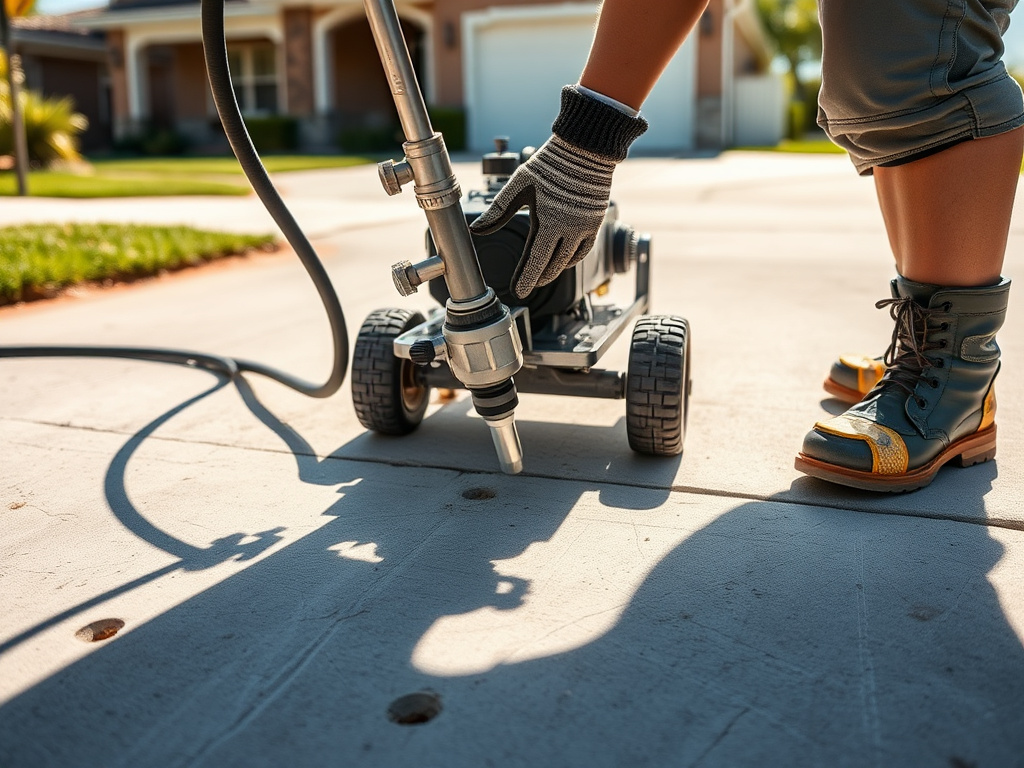
Queen Creek sits on a basin of expansive clay and caliche soil that swells when the monsoon soaks it and shrinks hard during the long dry season that follows. That repeated swell-shrink cycle is the single biggest reason concrete slabs settle unevenly here — a driveway apron sinks near the garage, a sidewalk panel drops a lip at the joint, a patio corner tips toward the yard. None of that means the concrete itself failed structurally; it usually means the soil underneath it moved.
Slab leveling raises the existing concrete back to grade rather than replacing it, which is faster and less disruptive than a tear-out. We use two proven methods depending on the situation: traditional mudjacking (pumping a cement-based slurry beneath the slab) and polyurethane foam injection (injecting a high-density expanding foam through small ports). Both raise the slab; they differ in cost, cure time, and long-term stability, and we'll walk you through which one fits your specific slab during a free on-site assessment.
Why property owners choose it
- Raises the existing slab back to a safe, usable grade in a matter of hours, not the days a full replacement takes.
- Costs a fraction of tear-out-and-repour for most driveway, sidewalk, and patio settlement.
- Fills the void left under the slab by shrinking clay soil, addressing the cause of settlement, not just the symptom.
- Minimal mess and no dumpster full of broken concrete to haul away.
- Works on driveways, sidewalks, patios, pool decks, garage slabs, and porch slabs alike.
Mudjacking vs. polyurethane foam lifting
Mudjacking is the traditional method — a cement, sand, and soil slurry is pumped through drilled holes to fill the void and raise the slab. It's a proven, budget-friendly approach that's been used for decades, and it typically runs in the $3 to $6 per square foot range as a general industry estimate. The tradeoff is added weight (the slurry itself is heavy, which can matter over genuinely unstable soil) and a cure window of roughly 24-48 hours before the slab can be driven or walked on with full confidence.
Polyurethane foam lifting uses a two-part expanding foam injected through small 5/8-inch ports, drilled much smaller than mudjacking's typical 1-2 inch holes. The foam cures in about 15 minutes, weighs a small fraction of mudjacking slurry (roughly 2 lb/cu ft versus 100+ lb/cu ft), and is water-resistant, which matters in a climate with a defined monsoon season. It generally runs higher per square foot, in the $5 to $25 range as a general industry estimate, but the faster turnaround and lighter load often make it the better fit for driveways, garage slabs, and anywhere continued soil movement is a concern.
- Mudjacking: lower cost, proven method, 24-48hr cure
- Polyurethane: smaller holes, ~15-min cure, lighter fill, better moisture resistance
Why Queen Creek slabs settle unevenly in the first place
Most of the settlement we see isn't random — it follows the soil. Queen Creek and the surrounding East Valley sit on ancient basin-fill deposits with caliche (a dense, calcium-carbonate-cemented layer) often found roughly 2 to 4 feet below grade, sitting above and mixed with expansive clay. During the monsoon (typically mid-June through the end of September), that clay absorbs moisture and swells; through the long dry season that follows, it shrinks back down and can pull away from the underside of a slab, leaving a void. Repeat that cycle enough summers in a row and a slab that started perfectly level develops real settlement at its weakest point — usually a joint, an edge, or wherever drainage concentrates water.
Ideal for
- A driveway apron or sidewalk panel that has sunk or created a trip-hazard lip at a joint
- A patio or pool deck slab tipping away from the house
- A garage slab that's settled at the door threshold
- Concrete that's structurally sound but sitting at the wrong elevation
What affects the cost
Slab Leveling questions, answered
As a general industry estimate, mudjacking typically runs $3 to $6 per square foot and polyurethane foam lifting typically runs $5 to $25 per square foot, with most contractors carrying a minimum job charge. Your exact number depends on slab size, how far it needs to rise, and the method used — a free on-site assessment gets you a firm quote.
If the underlying cause was a one-time soil void, leveling is typically a lasting fix. If the soil beneath your home is still actively cycling through severe swell-shrink seasons, some additional settlement over many years is possible with any repair method — including a full replacement, which sits on the same soil. Addressing drainage that's feeding water under the slab is often the single biggest factor in how long a leveling repair holds.
Slab Leveling done right, by a local Queen Creek crew
Slab Leveling isn't a commodity — the result depends entirely on how carefully it's diagnosed and executed for your specific slab and Queen Creek's real expansive soil. We assess what your concrete actually needs, prep the site properly, and work to the method that fits the problem, so the result holds up instead of needing the same fix again in a few years.
We serve Queen Creek, San Tan Valley, Gilbert, Chandler, Mesa, Apache Junction, Florence, and Coolidge. Every job starts with a free, no-pressure on-site assessment.
Just as important, we treat your property like the system it is. Concrete, drainage, and grading all interact, and fixing one while ignoring the others leaves the underlying cause in place. When we scope your slab leveling, we look at how it fits the whole picture — so the finished result performs the way it should, holds up through the next monsoon season, and actually solves the problem you called about.
Free assessment
We evaluate the concrete and give you a clear, itemized estimate.
Expert execution
We prep the site and complete your slab leveling to spec — clean and on schedule.
A fix that holds
A properly diagnosed repair, honest advice, and work built for real Queen Creek soil.
Related services
Ready for a free slab leveling estimate?
Tell us about your driveway, patio, or slab and we'll put together a clear, no-pressure estimate — built for Queen Creek's real soil and climate.