New Concrete Pours & Flatwork
New concrete for driveways, patios, walkways, and equipment pads — poured with the base prep and joint layout that expansive Queen Creek soil actually requires.
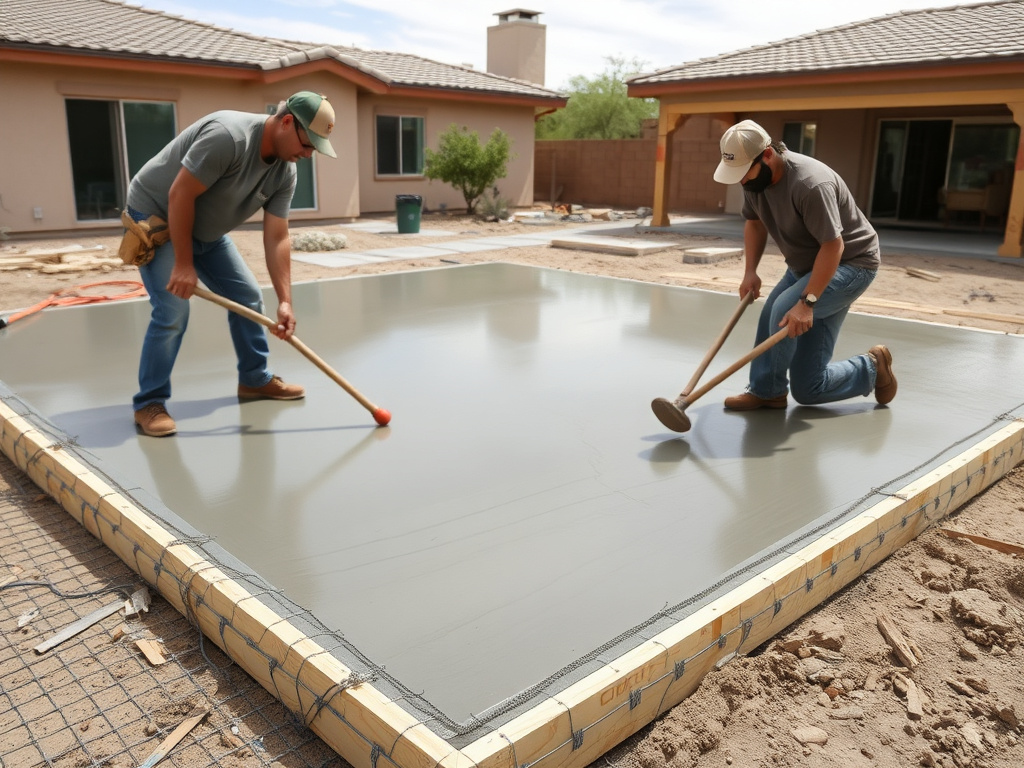
New concrete flatwork is where most future problems get prevented or built in. A new driveway, patio, sidewalk, or pad poured on Queen Creek's expansive clay and caliche without proper base compaction, reinforcement, and control-joint spacing is set up for exactly the same settlement and cracking issues we get called out to repair on older slabs — just faster, since new concrete hasn't had decades to slowly work through it.
We pour new flatwork for homeowners adding a patio or walkway, builders and property owners needing pads for sheds, generators, or equipment, and anyone replacing a driveway or sidewalk section that's beyond repair. Every pour starts with proper site prep for our specific soil conditions, not a generic template.
Why property owners choose it
- Proper base compaction and moisture conditioning specifically for expansive clay and caliche soil, not a one-size-fits-all approach.
- Reinforcement (rebar or wire mesh) sized to the application and expected load.
- Control joints spaced and cut to actually control where cracking happens, rather than leaving it to chance.
- Broom, stamped, or decorative finish options on every new pour.
- A new slab built to hold up through its first several monsoon-to-dry-season cycles, not just look good on install day.
Why base prep matters more here than almost anywhere else
In a lot of the country, a new concrete pour's biggest risk is winter freeze-thaw. In Queen Creek, the bigger long-term risk is the same expansive-soil swell-shrink cycle that causes settlement on older slabs — and it starts working on a new pour from day one if the base wasn't properly prepared. That means removing organic material and loose fill, compacting a proper aggregate base course, and in some cases moisture-conditioning the subgrade before concrete ever goes down, so the slab has a stable, predictable foundation instead of raw expansive clay directly underneath it.
- Proper aggregate base course, compacted in lifts
- Control joints spaced to the slab's actual dimensions and load
- Reinforcement sized to the application, not a flat default
Finish options for new flatwork
Standard broom finish is the most cost-effective and provides reliable slip resistance for driveways and walkways. Stamped and decorative finishes (covered in more detail on our stamped concrete page) work well for patios, courtyards, and pool decks where appearance matters as much as function. We'll talk through finish options, cost, and maintenance expectations for each during your free on-site assessment.
Ideal for
- New patios, walkways, or courtyard flatwork
- Driveway sections or full driveways beyond economical repair
- Sheds, generators, HVAC, and equipment pads
- New sidewalks or approach slabs for a remodel or addition
What affects the cost
New Pours & Flatwork questions, answered
New concrete is typically safe to walk on within 24-48 hours and ready for vehicle traffic in about 7 days, though it continues curing and gaining strength for roughly 28 days total. We'll give you exact timing for your specific pour and mix design.
Any slab poured on expansive soil carries some long-term settlement risk — that's a soil characteristic, not a workmanship failure. Proper base compaction, moisture conditioning, and correctly spaced control joints significantly reduce that risk and are exactly what separates a new pour that holds up for decades from one that needs leveling in a few years.
New Pours & Flatwork done right, by a local Queen Creek crew
New Pours & Flatwork isn't a commodity — the result depends entirely on how carefully it's diagnosed and executed for your specific slab and Queen Creek's real expansive soil. We assess what your concrete actually needs, prep the site properly, and work to the method that fits the problem, so the result holds up instead of needing the same fix again in a few years.
We serve Queen Creek, San Tan Valley, Gilbert, Chandler, Mesa, Apache Junction, Florence, and Coolidge. Every job starts with a free, no-pressure on-site assessment.
Just as important, we treat your property like the system it is. Concrete, drainage, and grading all interact, and fixing one while ignoring the others leaves the underlying cause in place. When we scope your new pours & flatwork, we look at how it fits the whole picture — so the finished result performs the way it should, holds up through the next monsoon season, and actually solves the problem you called about.
Free assessment
We evaluate the concrete and give you a clear, itemized estimate.
Expert execution
We prep the site and complete your new pours & flatwork to spec — clean and on schedule.
A fix that holds
A properly diagnosed repair, honest advice, and work built for real Queen Creek soil.
Related services
Ready for a free new pours & flatwork estimate?
Tell us about your driveway, patio, or slab and we'll put together a clear, no-pressure estimate — built for Queen Creek's real soil and climate.