Repair or Replace? How to Decide on a Cracked Driveway or Patio
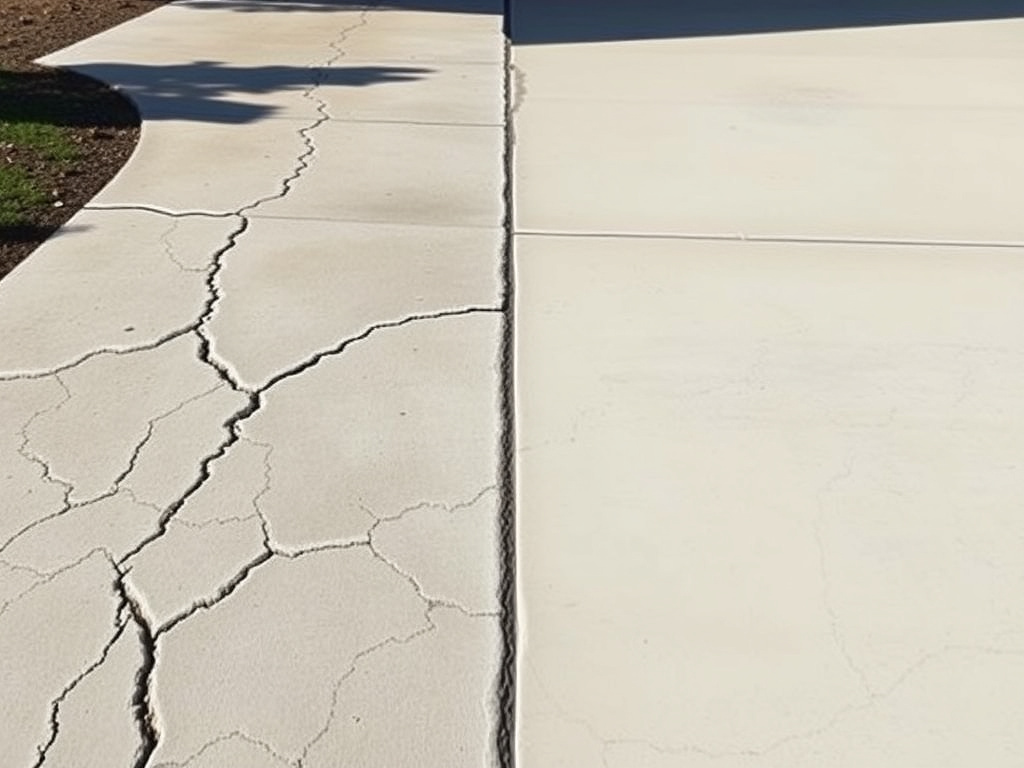
Once a driveway or patio starts showing real damage — multiple cracks, a settled section, a rough or pitted surface — the question every Queen Creek homeowner asks is the same: is this something worth repairing, or has it reached the point where replacement is the smarter long-term move? There's a real, honest answer to that question, and it depends on a handful of specific factors rather than a gut feeling about the concrete's age.
Start with what's actually wrong
"My driveway has a problem" isn't specific enough to answer the repair-vs-replace question. The right starting point is identifying which category the damage falls into, since each points toward a different fix.
Cosmetic and stable cracking
Hairline cracks that aren't widening, aren't offset, and aren't tied to visible settlement are almost always a repair — specifically, sealing — situation. This is the least expensive category of damage and the easiest to fully resolve without touching the rest of the slab.
Structural or widening cracks
Cracks with a vertical offset, ones that have visibly grown, or ones running in a pattern connected to settlement need structural injection repair rather than simple sealing. This is still meaningfully cheaper than replacement and, when the crack is isolated, doesn't require touching the surrounding concrete.
Localized settlement
A single sunken section — a driveway apron, a sidewalk panel, a patio corner — while the rest of the slab remains sound is a strong candidate for slab leveling (mudjacking or polyurethane lifting) rather than replacement. This raises the affected section back to grade without disturbing anything that isn't actually broken.
Uniform surface wear
Pitting, scaling, or a generally rough, tired-looking surface across the whole driveway — without major structural cracking underneath — is the classic resurfacing scenario. A new bonded overlay gives you a completely refreshed surface while keeping the existing, structurally sound slab as the base.
Extensive structural failure
Multiple sections settled unevenly, cracking running through a large percentage of the slab, or concrete that's genuinely reached the end of its structural life — this is where replacement becomes the more sensible long-term investment, even though it costs more upfront than any of the repair categories above.
- Stable hairline cracking → sealing
- Structural or widening cracks → injection repair
- One settled section, rest sound → slab leveling
- Uniform surface wear, structurally sound → resurfacing
- Extensive multi-section failure → replacement
Factor in what's driving the damage
Two driveways with similar-looking cracks can call for different decisions depending on the cause. Damage from a one-time event — a shrinkage crack from the original pour, an isolated soil void from an old drainage issue that's since been fixed — is a strong repair candidate, since the underlying cause isn't actively ongoing. Damage that's clearly tied to an unresolved, ongoing issue — active drainage problems still feeding water to unstable soil, for instance — is worth addressing at the source (regrading, downspout redirection) alongside whichever repair or replacement decision you make, or the same damage pattern is likely to return.
Consider the economics honestly
As a rough framework, repair and resurfacing options generally run a fraction of full replacement cost. That math almost always favors repair when the concrete is a strong repair candidate. Where it gets genuinely close is a driveway with moderate-to-significant damage that's borderline between "extensive repair" and "replacement" — in those cases, we'll walk you through both options with real numbers rather than pushing toward whichever is more profitable for us, because a homeowner who trusts that advice is worth more long-term than one extra replacement sale.
A note on timing the decision
If you're on the fence and the damage is currently in the "stable, repairable" category, there's real value in acting now rather than waiting: repair costs less than the replacement that stable damage can eventually become if it's left through enough monsoon-to-dry-season cycles. If your concrete is already clearly past that point, waiting doesn't typically make the eventual replacement any cheaper, and it does mean living with a bigger trip hazard or eyesore in the meantime.
Frequently asked questions
Absolutely, and we'd encourage it for any project at the replacement price point. We'll give you an honest assessment of your specific concrete, including whether we think repair or resurfacing could reasonably solve the problem instead — even if that means a smaller job for us.
Sometimes, since concrete ages and weathers unevenly, and an exact color match on an isolated patch isn't always achievable. For driveways where a patch would be visually noticeable, a full resurface often gives a more uniform, satisfying result than a patched repair — we'll talk through that tradeoff honestly during your assessment.
Ready for a free estimate?
Tell us about your project and we'll build a clear, no-pressure estimate.